
Jul 14th 2026
Cyclosporiasis Cases are Surging
Cyclosporiasis cases are surging across the United States this summer. As of the most recent state update, Michigan has confirmed more than 3,300 cyclosporiasis cases since late June. Nationally, the CDC has confirmed 843 domestically acquired cases across 31+ states since May 1, though they have said this national figure likely undercounts the true total, with more than 1,500 additional reported cases still under review. Combined Michigan and Ohio case counts alone have topped 3,000, making this the largest cyclosporiasis outbreaks the US has seen in years.
Cyclosporiasis is caused by Cyclospora cayetanensis, a microscopic parasite typically spread through food or water contaminated with feces, most often linked to fresh produce. According to the CDC’s overview of Cyclosporiasis, symptoms include watery diarrhea, cramping, bloating, and low-grade fever, usually appearing 2-14 days after exposure and can persist for weeks if left untreated.
The outbreak is centered in southeast Michigan and Ohio, though cases have now been reported in 31 states total. A specific source has not been confirmed, but Michigan health officials have flagged lettuce and salad greens as a likely link and are recommending that people buy whole heads of lettuce rather than pre-washed, bagged salad kits as a precaution while the investigation continues. The CDC and FDA are actively conducting a traceback investigation.
Because symptoms can resemble other gastrointestinal illnesses, and because routine stool testing doesn’t always screen for Cyclospora automatically, health officials are urging providers to specifically consider and test for cyclosporiasis in patients presenting with prolonged GI symptoms. The MDHHS public health bulletin for healthcare providers has more detail on testing and reporting guidance.
Clinical Note: Because Cyclospora oocysts are not detected by standard ova and parasite (O&P) examinations or routine stool cultures, health officials urge providers to explicitly request Cyclospora testing or order gastrointestinal PCR panels for patients presenting with prolonged diarrheal illness.
Public health investigators have also pointed out that federal surveillance for foodborne pathogens like Cyclospora has narrowed in the past year. A CDC program, FoodNet, who proactively contact labs for test results, scaled back in 2025 and now focus on two pathogens. This makes accurate, timely lab level testing and reporting more important than ever in tracking outbreaks.
As awareness spreads and labs order Cyclospora specific testing more often, labs may see a meaningful and sustained uptick in requests, including from labs that do not typically run this test and may need to add capacity quickly. With cases still climbing and no confirmed source yet, elevated testing volume is likely to continue for weeks.
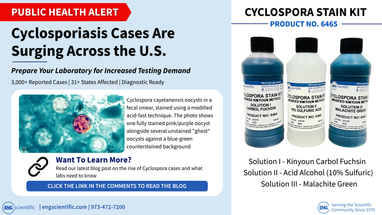
Identifying Cyclospora requires a stain designed to make the parasite visible under the microscope. This Cyclospora Stain Kit (Modified Kinyoun Method) is a standard staining approach used for this purpose.
ENG Scientific manufactures a Cyclospora Kit (Product No. 6465), giving diagnostic labs a straightforward way to scale up Cyclospora identification. The kit includes three ready to use solutions and each kit is shipped ready to use.
In addition to the kit, each solution is also available to purchase individually.
If your lab is seeing increased requests for Cyclospora identification, or want to add this capability ahead of this continued case growth, contact ENG Scientific at (943) 472-7200 or info@engscientific.com.
Sources:
https://www.michigan.gov/mdhhs/keep-mi-healthy/infectious-diseases/cyclosporiasis-outbreak
https://www.cdc.gov/cyclosporiasis/about/index.html
https://www.cdc.gov/cyclosporiasis/php/surveillance/index.html
https://www.michigan.gov/mdhhs/keep-mi-healthy/infectious-diseases/infectious-disease-outbreaks